





© 2026 InterSystems Corporation. All rights reserved.Privacy & TermsGuaranteeSection 508Contest Terms


zapm 

Community Project
This project is maintained by its author and is not officially supported by InterSystems. For technical support, please contact the project developer.
This project is maintained by its author and is not officially supported by InterSystems. For technical support, please contact the project developer.
4.5
1 reviews
1
Awards
1.0k
Views
265
IPM installs
 1
1 Add to bundle
Details
Releases (44)
Reviews (1)
Awards (1)
Issues
Articles (1)
Dependants (2)

And now ZAPM has survived to the first version and can add any command that I need and remember it so that I can re-execute it.
What's new in this version
added support OEX repos to pick command

zapm



ZAPM is a shell - extends the ZPM shell and adds any other commands.
Working in the terminal I got tired of going from my shell to the zpm shell and back.
My shell was supplied with additional specific commands and I decided to merge the two shells.
The ZAPM checks if the command entered is a ZPM command, then sends the execution to the ZPM shell.
Then I wanted to improve the color commands and expand the functionality.
And now ZAPM has survived to the first version and can add any command that I need and remember it so that I can re-execute it.
What’s new
Added command: pick
This is an analogue of the find and install command for viewing and loading packages from alternative sources directly from the repositories
ZAPM commands extention:
pick <context>
- Pick modules by name or context and load from repository.
- Pick -u Upgrade load from repository.
- Pick -a Output all information from the OEX repository.
- Pick -n Displaying all OEX repo information reverse sorted by publication date.
- Pick -n 15 Displaying all repo information from OEX older than 15 days.
- Pick -p </dir/filename.log> Output all information from the OEX repository to a file.
Installation with ZPM
If the current ZPM instance is not installed, then in one line you can install the latest version of ZPM even with a proxy.
s r=##class(%Net.HttpRequest).%New(),proxy=$System.Util.GetEnviron("https_proxy") Do ##class(%Net.URLParser).Parse(proxy,.pr) s:$G(pr("host"))'="" r.ProxyHTTPS=1,r.ProxyTunnel=1,r.ProxyPort=pr("port"),r.ProxyServer=pr("host") s:$G(pr("username"))'=""&&($G(pr("password"))'="") r.ProxyAuthorization="Basic "_$system.Encryption.Base64Encode(pr("username")_":"_pr("password")) set r.Server="pm.community.intersystems.com",r.SSLConfiguration="ISC.FeatureTracker.SSL.Config" d r.Get("/packages/zpm/latest/installer"),$system.OBJ.LoadStream(r.HttpResponse.Data,"c") zn "%SYS" zpm "install zapm"
Or install native from repo latest betta version
s r=##class(%Net.HttpRequest).%New(),proxy=$System.Util.GetEnviron("https_proxy") Do ##class(%Net.URLParser).Parse(proxy,.pr) s:$G(pr("host"))'="" r.ProxyHTTPS=1,r.ProxyTunnel=1,r.ProxyPort=pr("port"),r.ProxyServer=pr("host") s:$G(pr("username"))'=""&&($G(pr("password"))'="") r.ProxyAuthorization="Basic "_$system.Encryption.Base64Encode(pr("username")_":"_pr("password")) set r.Server="github.com",r.SSLConfiguration="ISC.FeatureTracker.SSL.Config" d r.Get("/intersystems-community/zpm/releases/download/v0.4.1-beta.9/zpm-0.4.1-beta.9.xml"),$system.OBJ.LoadStream(r.HttpResponse.Data,"c")
If ZPM is installed, then ZAPM can be set with the command
zpm:USER>install zapm
or install native fpom repo with latest version
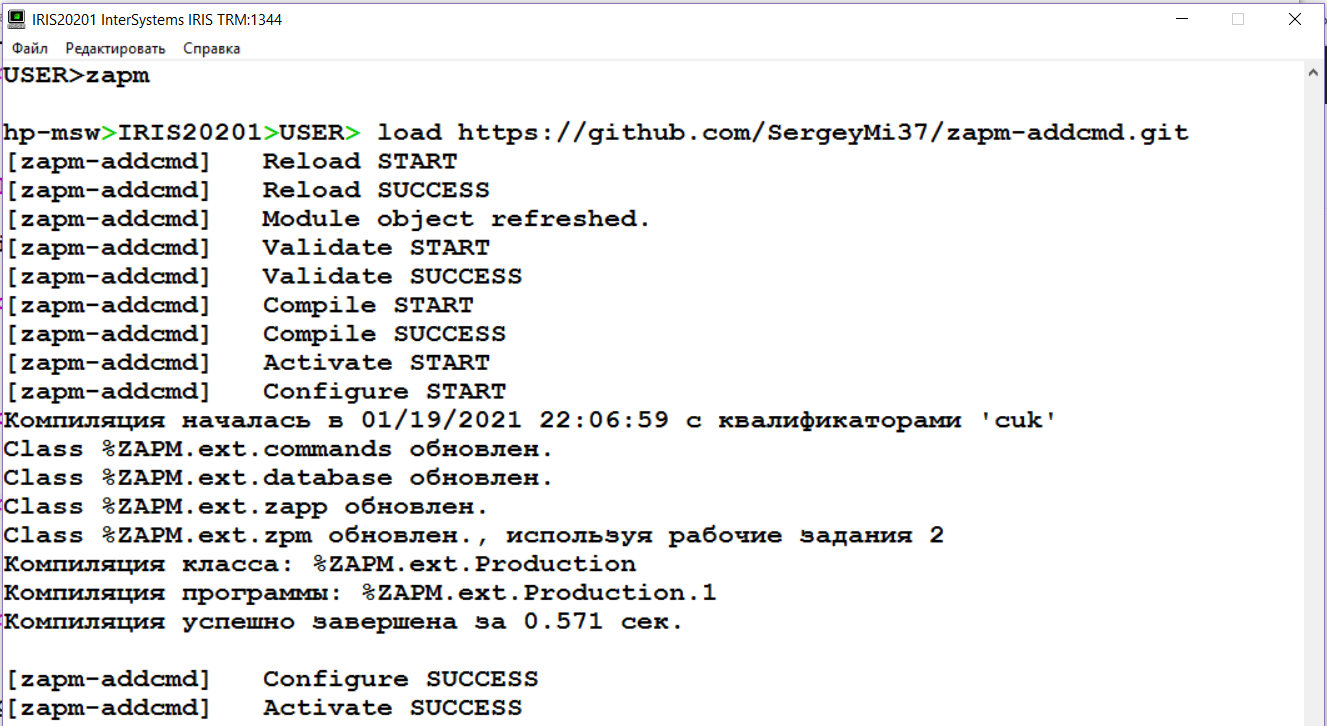
zpm:USER>install https://github.com/SergeyMi37/zapm
Installation with Docker
Prerequisites
Make sure you have git and Docker desktop installed.
Installation
Clone/git pull the repo into any local directory
$ git clone https://github.com/SergeyMi37/zapm.git
Open the terminal in this directory and run:
$ docker-compose build
Run the IRIS container with your project:
$ docker-compose up -d
How to Test it
Open IRIS terminal:
$ docker-compose exec iris iris session iris
USER>
USER>zapm "cmd"

Command extensions zpm.
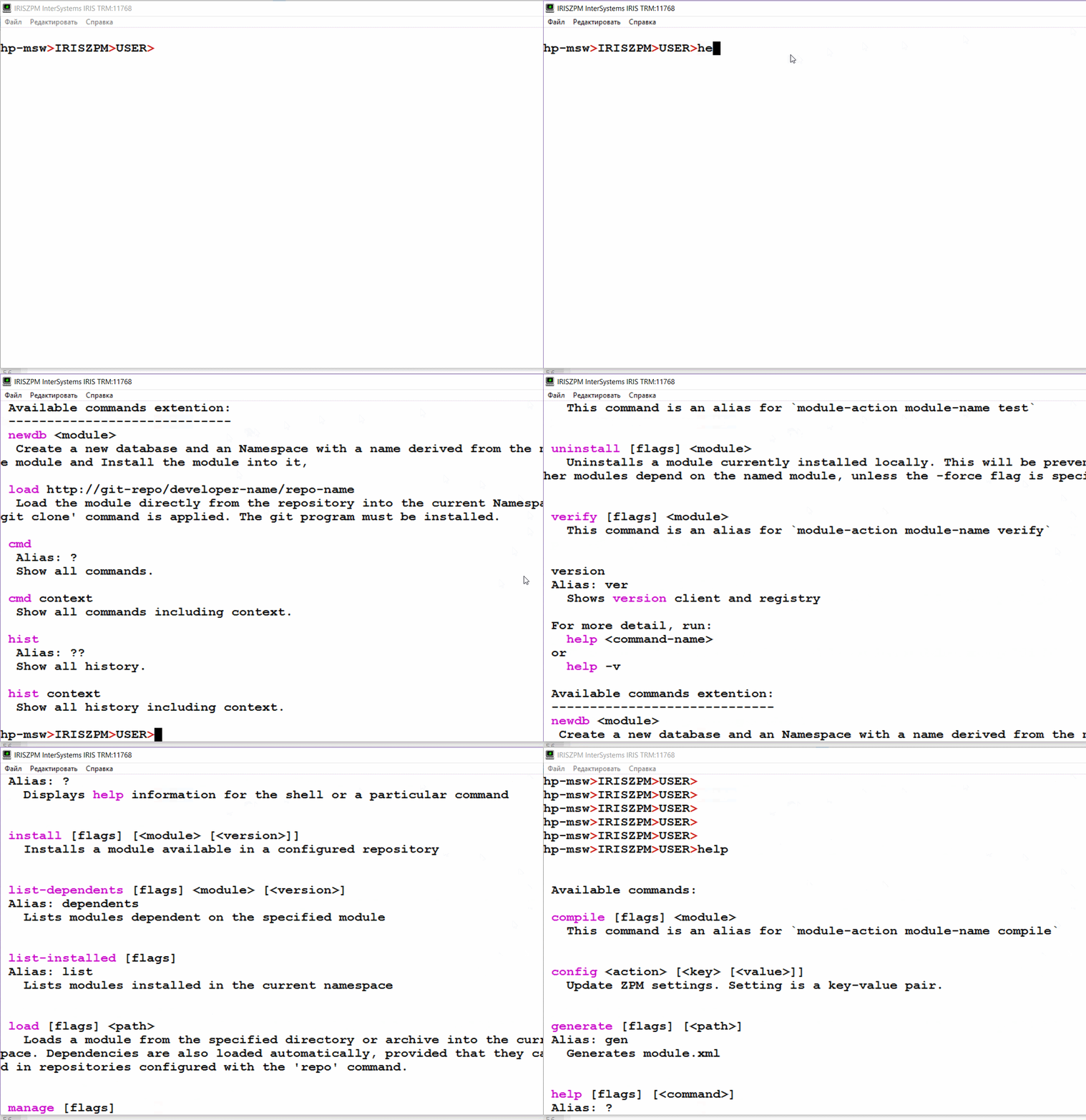
help - coloring command description
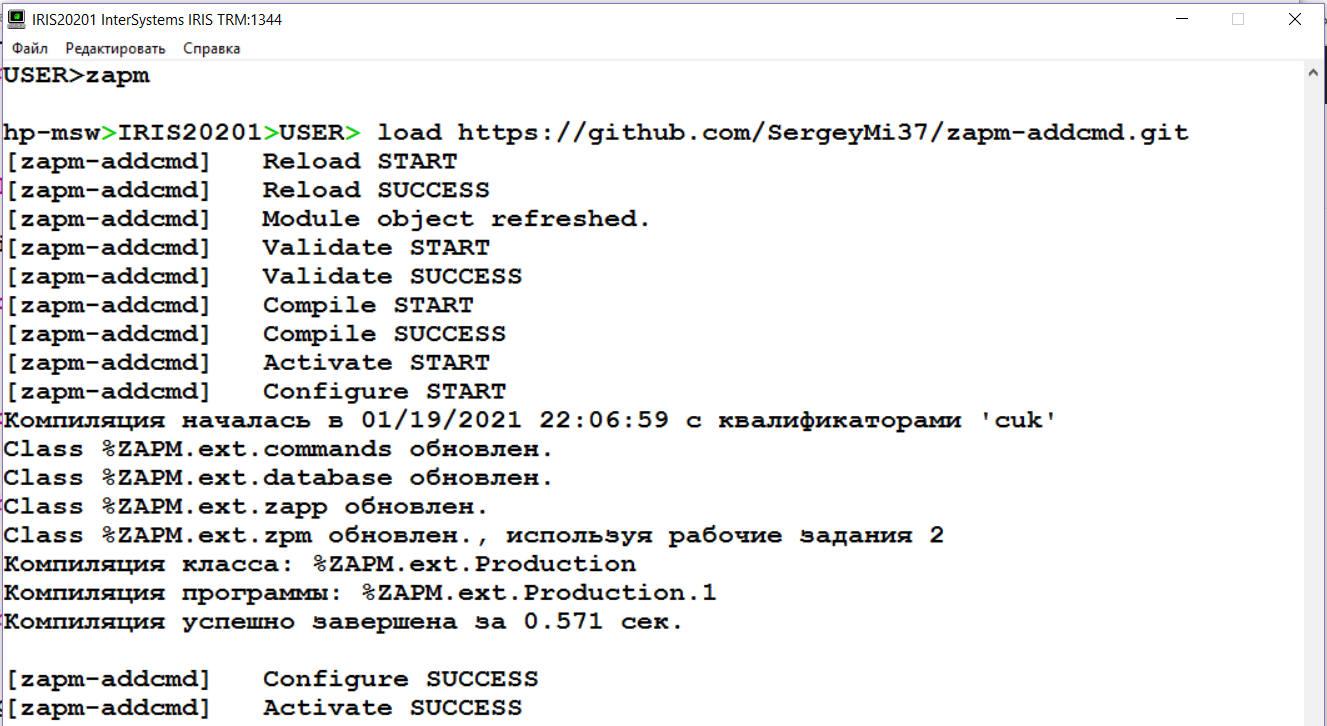
load <https…git-repo> - loading the module directly from the git-repository
show modules with context by repository URL

Additional commands.
Commands for working with databases and namespaces:
dbcreate - create a database with %DB resources ans namespace and interoperability mapping.
USER>zapm "dbcreate testdb3 -p d:/!/database/durable"
dbdelete - delete a database with %DB resources ans namespace.
USER>zapm "dbdelete testdb3"
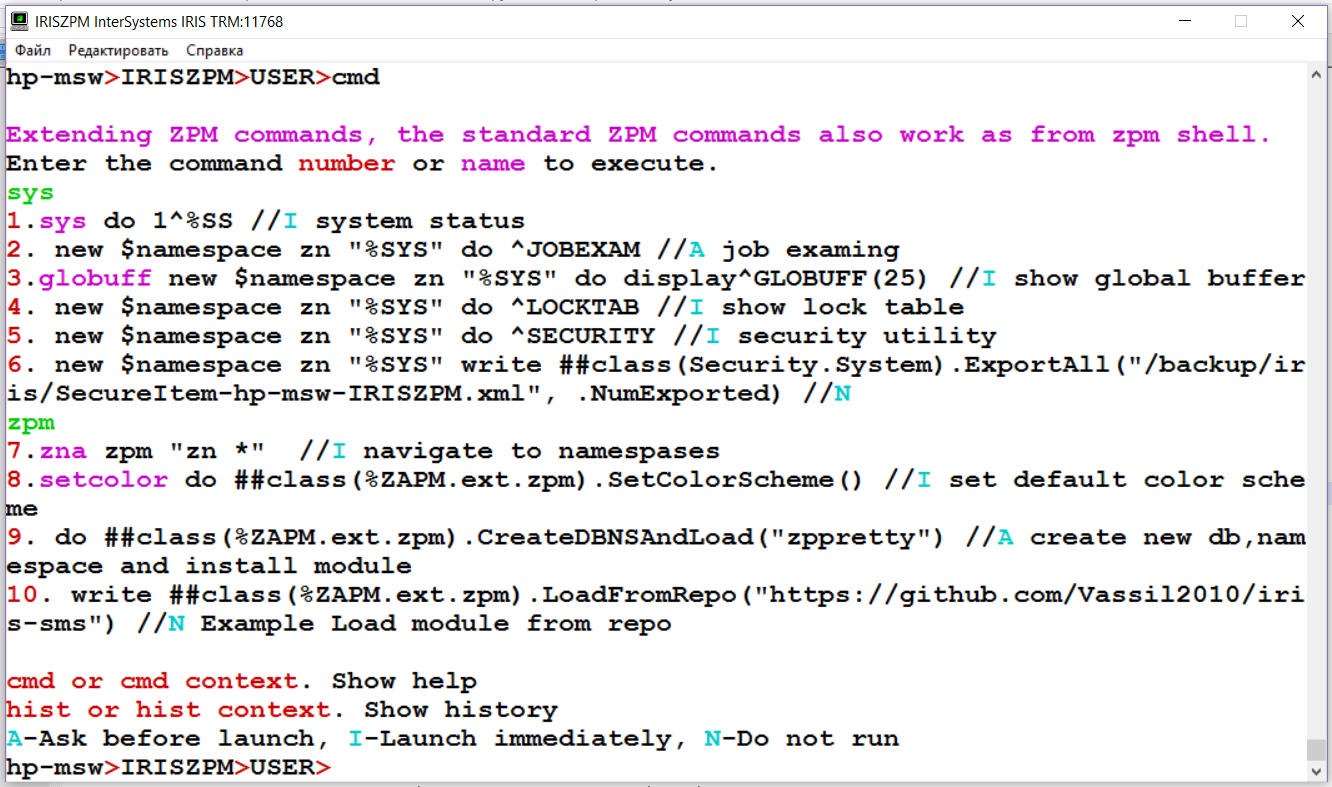
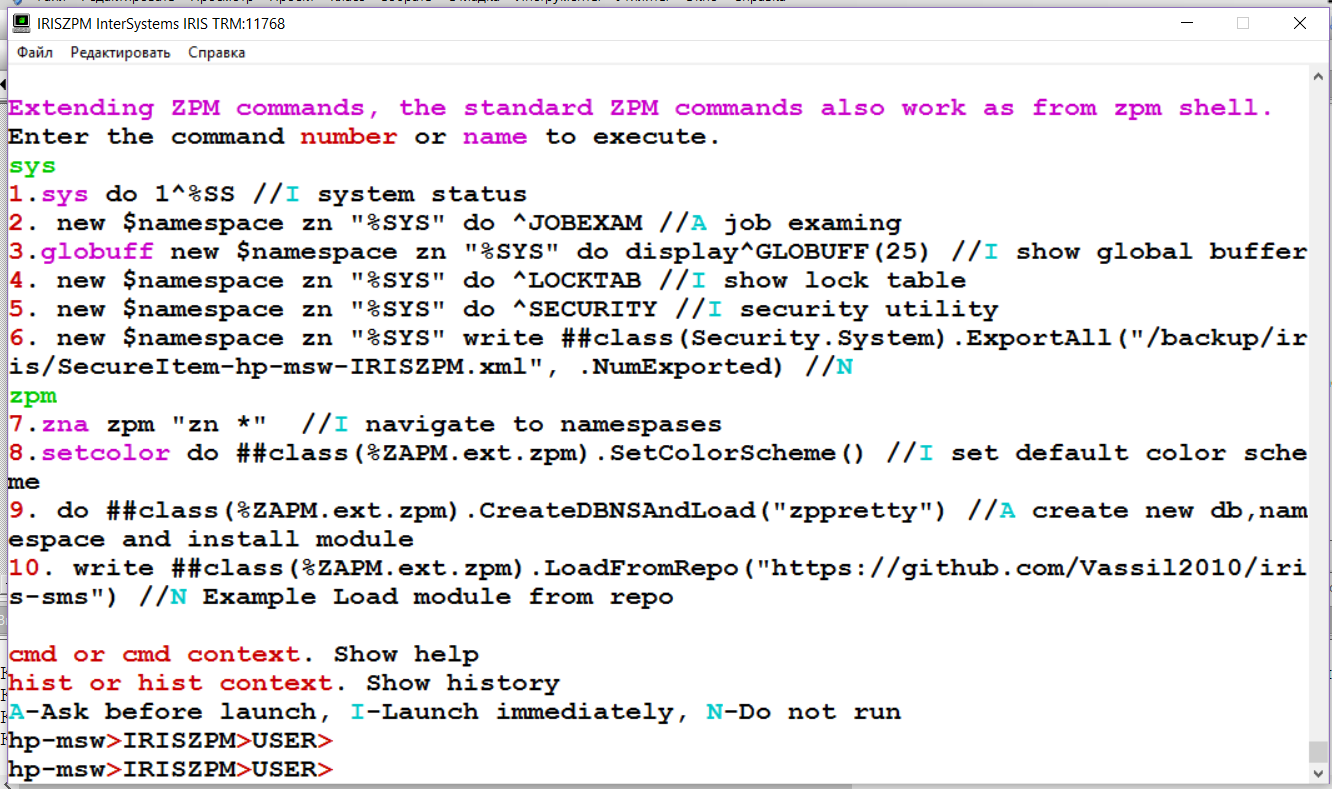
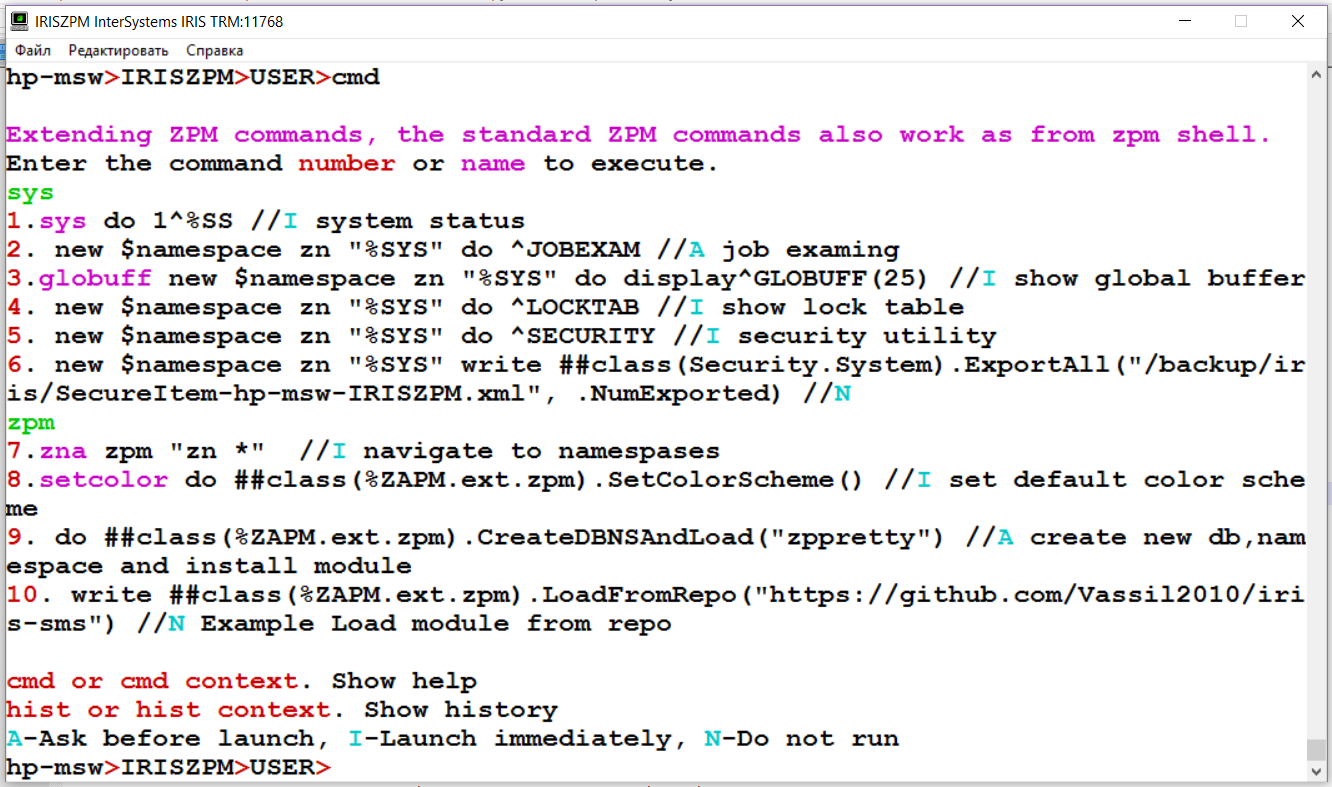
cmd - list of possible additional commands
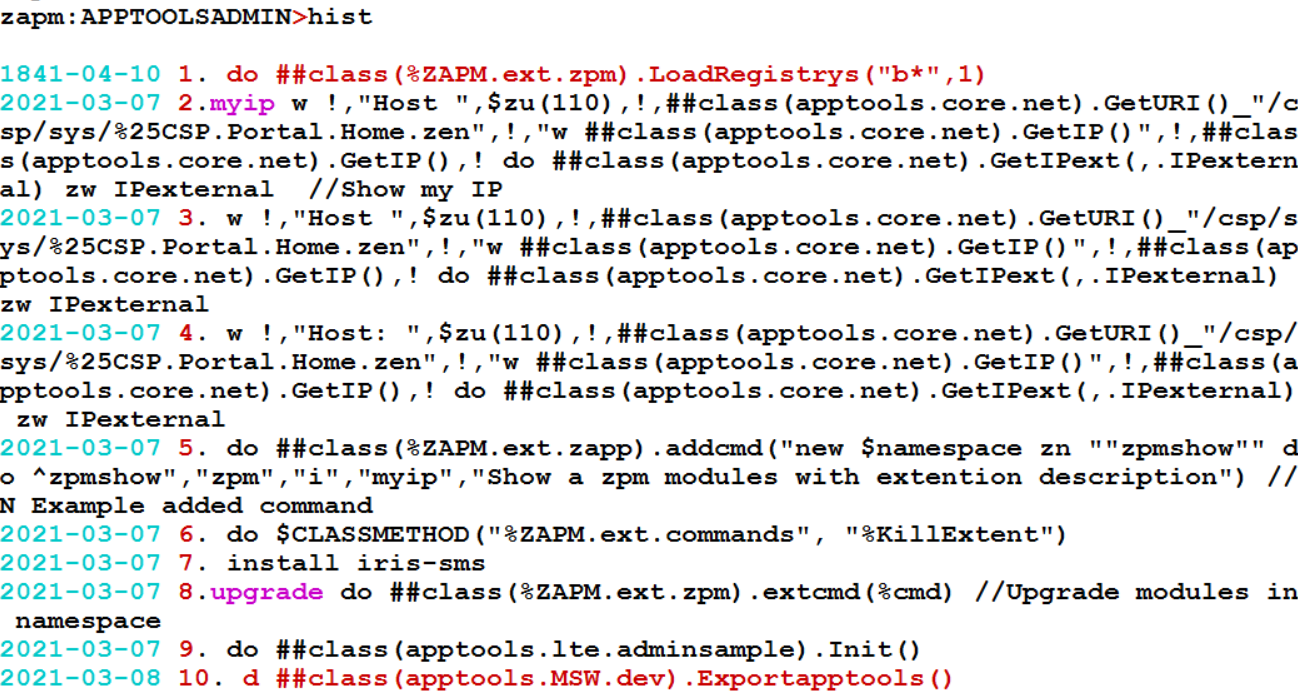
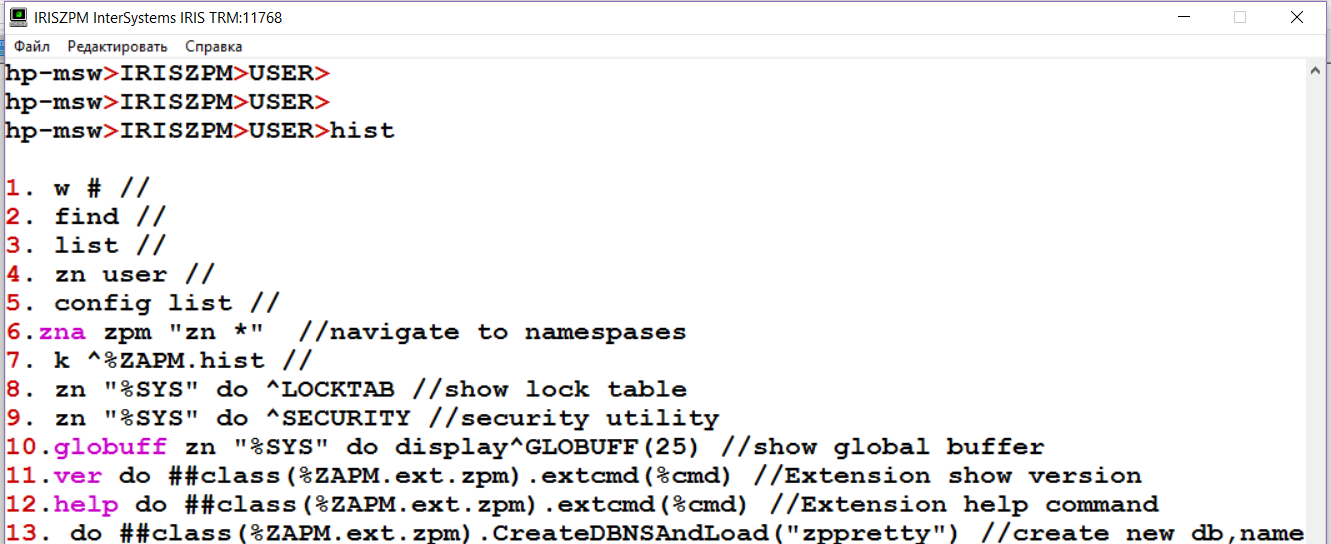
hist - list of executed commands
newdb -creating a database with a scope and installing the module there
To add a new command to the zapm shell, use the ##class(%ZAPM.ext.zapp).addcmd
For example, let’s execute sequentially
- create a database with the area and install the zpmshow module there
hp-msw>IRISZPM>USER> newdb zpmshowCreating Database zpmshow... done! Creating Namespace zpmshow... done! Creating Interoperability mappings ... done! Adding Interoperability SQL privileges ... done! Creating CSP Application ... done!
zpm "install zpmshow" [zpmshow] Reload START [zpmshow] Reload SUCCESS [zpmshow] Module object refreshed. [zpmshow] Validate START [zpmshow] Validate SUCCESS [zpmshow] Compile START [zpmshow] Compile SUCCESS [zpmshow] Activate START [zpmshow] Configure START [zpmshow] Configure SUCCESS [zpmshow] Activate SUCCESS
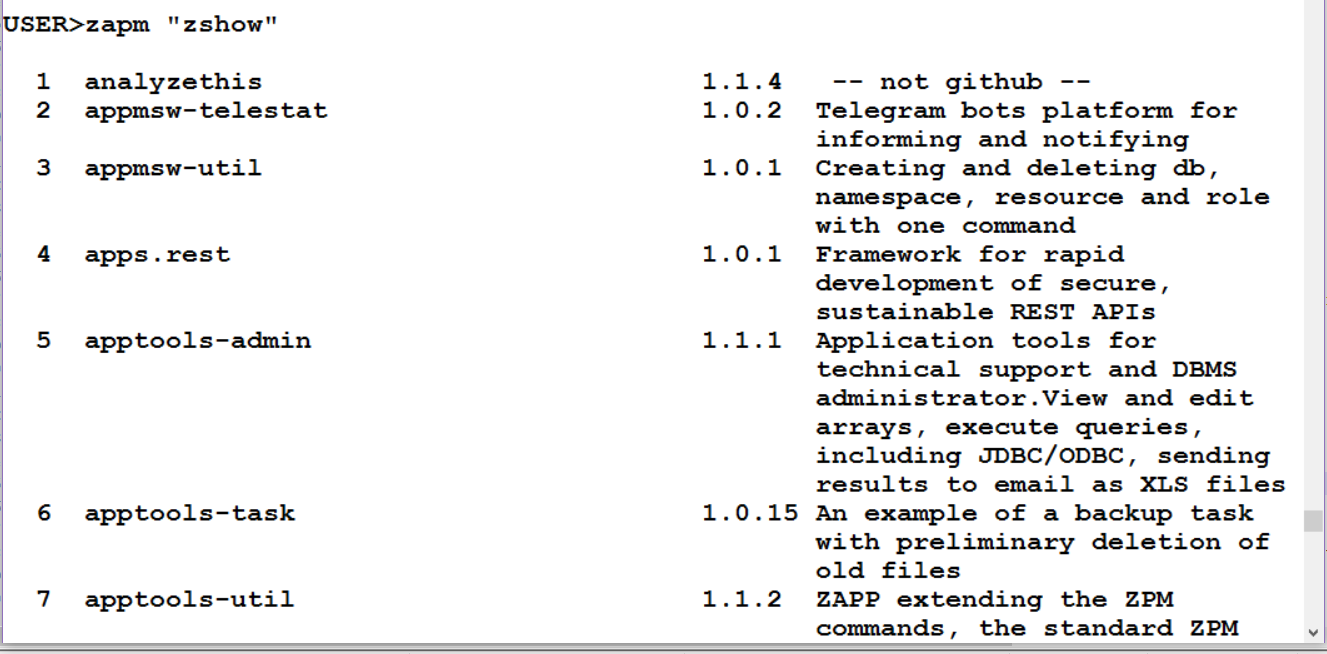
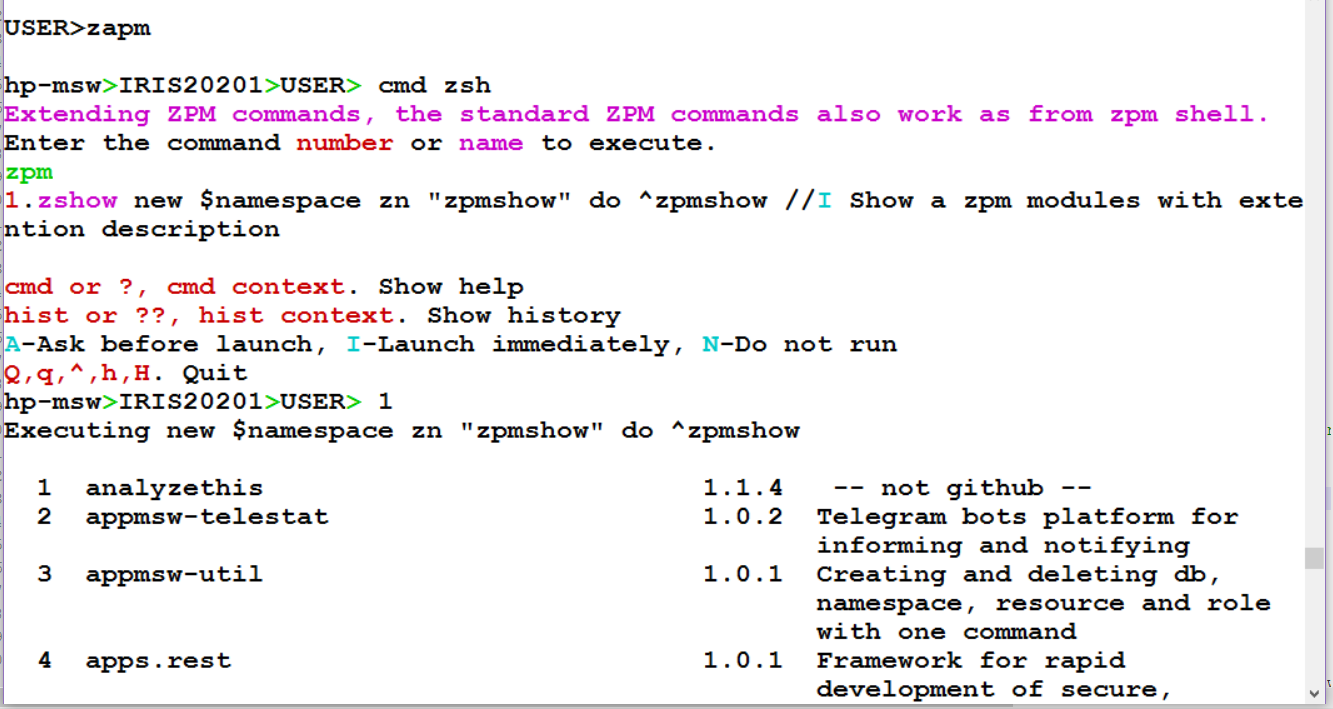
- add a new command named zshow, which should be executed immediately.
do ##class(%ZAPM.ext.zapp).addcmd("new $namespace zn ""zpmshow"" do ^zpmshow", "zpm", "i", "zshow", "Show a zpm modules with extention description")
added

- check the execution of the new command from the system shell
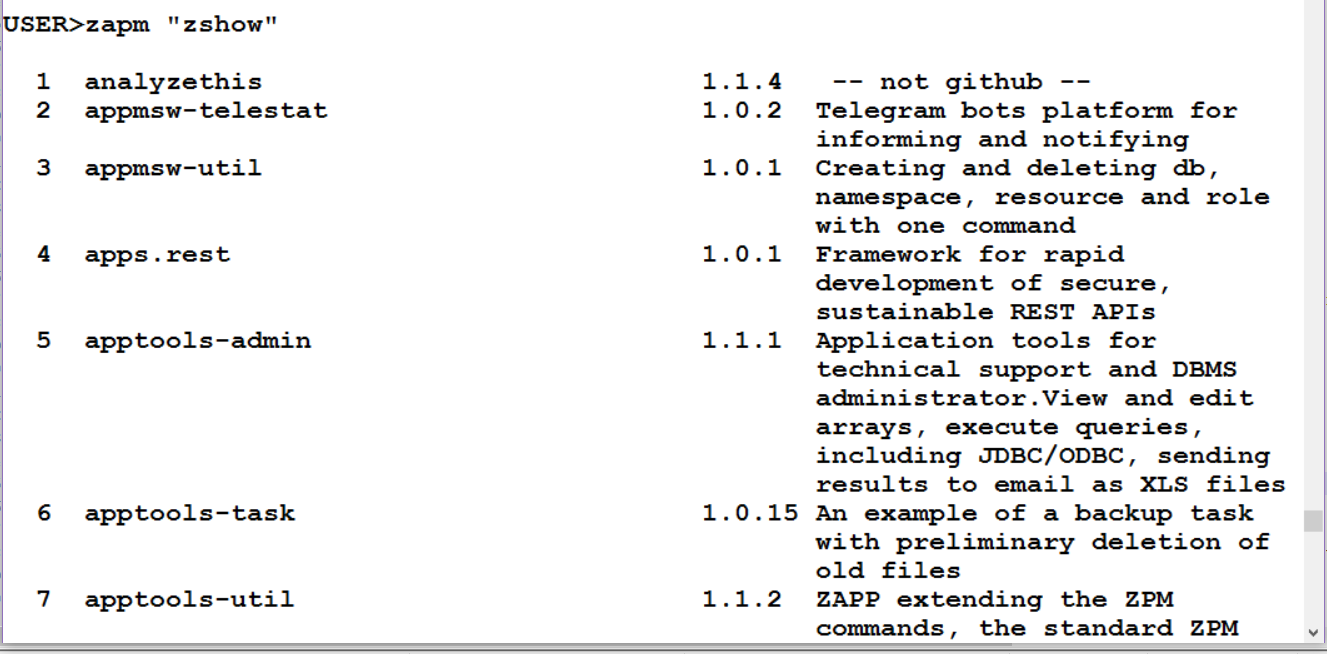
USER>zapm “zshow” - or from the zapm shell
Added commands: Working with Products and Tasks, start and stop in all namespaces.
interoperability Alias: prod Group work with all Products, info status, start and stop.prod list Show all namespaces and productions.
prod only Show only productions.
prod save Save the current status for subsequent recovery after the start. Those products that worked will work, and those that did not work will not.
prod stop Remember the current state of all products, and then stop everything
prod start start all products prod recover Recover all products task Group work with all custom tasks, info status, suspend and resume.
task list View all tasks and their statuses.
task save Save the current status for subsequent recovery after the start. Those tasks that worked will work, and those that did not work will not.
task stop Suspend all users tasks.
task start Resume all users tasks.
This solution can replace not only the zpm shell but also the main terminal shell.
For me it almost happened ;-)
Last checked by moderator
22 Nov, 2025, Works
Made with
Install
 zpm install zapm
  download archive
 Version
1.0.5401 Nov, 2023
Category
SolutionsWorks with
InterSystems IRISInterSystems IRIS for HealthFirst published
19 Jan, 2021Last edited
01 Nov, 2023