© 2026 InterSystems Corporation. All rights reserved.Privacy & TermsGuaranteeSection 508Contest TermsCode of ConductModeration PolicyCookies Settings


PaymentGuard AI 

Community Project
This project is maintained by its author and is not officially supported by InterSystems. For technical support, please contact the project developer.
This project is maintained by its author and is not officially supported by InterSystems. For technical support, please contact the project developer.
0
0 reviews
0
Awards
238
Views
4
IPM installs
 3
 Add to bundle

Details
Releases (3)
Reviews
Issues
Videos (1)
Articles (2)

AI Hub agent as fraud decision-maker inside an IRIS production — payments and healthcare claims
What's new in this version
IPM package 0.5.0 — install and dashboard fixes.
- Dashboard now matches the live demo: Decision feed & cases / Human review tabs, decision-detail dialog with embedded Flow replay and vector neighbors, calmer polling with a 10s test-action cooldown.
- Admin: anonymous usage analytics and a password-protected admin page.
- IPM install: dashboard files now land in the IRIS CSP directory (
${cspdir}) and the/csp/paymentguardweb app has itsPathset, sozpm "install paymentguard"serves the dashboard correctly. README documents the IPM-client andenable -communityprerequisites. - UTF-8 BOM on the HTML pages so they render correctly even when CSP labels static files ISO-8859-1.
PaymentGuard AI
An AI Hub agent making live payment-risk decisions inside an InterSystems IRIS interoperability production.
PaymentGuard AI is a payment-authorization workflow built with the IRIS 2026.3 AI Hub Early Access build. Every inbound payment flows through an interoperability production where a hybrid decision strategy applies:
- Deterministic rules first — sanctions, blacklists, hard limits and velocity spikes are blocked instantly, and fully-trusted payments are approved instantly, with zero LLM cost.
- The gray zone goes to an AI Hub agent — a real
%AI.Agent(“AI Risk Agent”) with read-only SQL tools over the payment platform’s own data. It grounds its APPROVE / REVIEW / BLOCK decision in live customer history, velocity, device reputation and merchant statistics. - Fail-safe by design — if the agent errors, times out or returns malformed output, the payment degrades to a human-review queue, never to a silent approve and never to a blind block.
Every decision — rules, agent, mock or fallback — lands in an immutable audit record with full cost observability: prompt/completion tokens, tool-call count, latency, model and the persisted AI Hub session id (replayable via %AI.Agent.Session).
Built for the InterSystems Programming Contest: AI Agent in Interoperability Workflows (Oct–Nov 2026).
🏆 Voting is open through November 15, 2026. If PaymentGuard AI looks useful to you, please vote for it on Open Exchange — find PaymentGuard AI in the list and click Vote. Thank you!
Demo
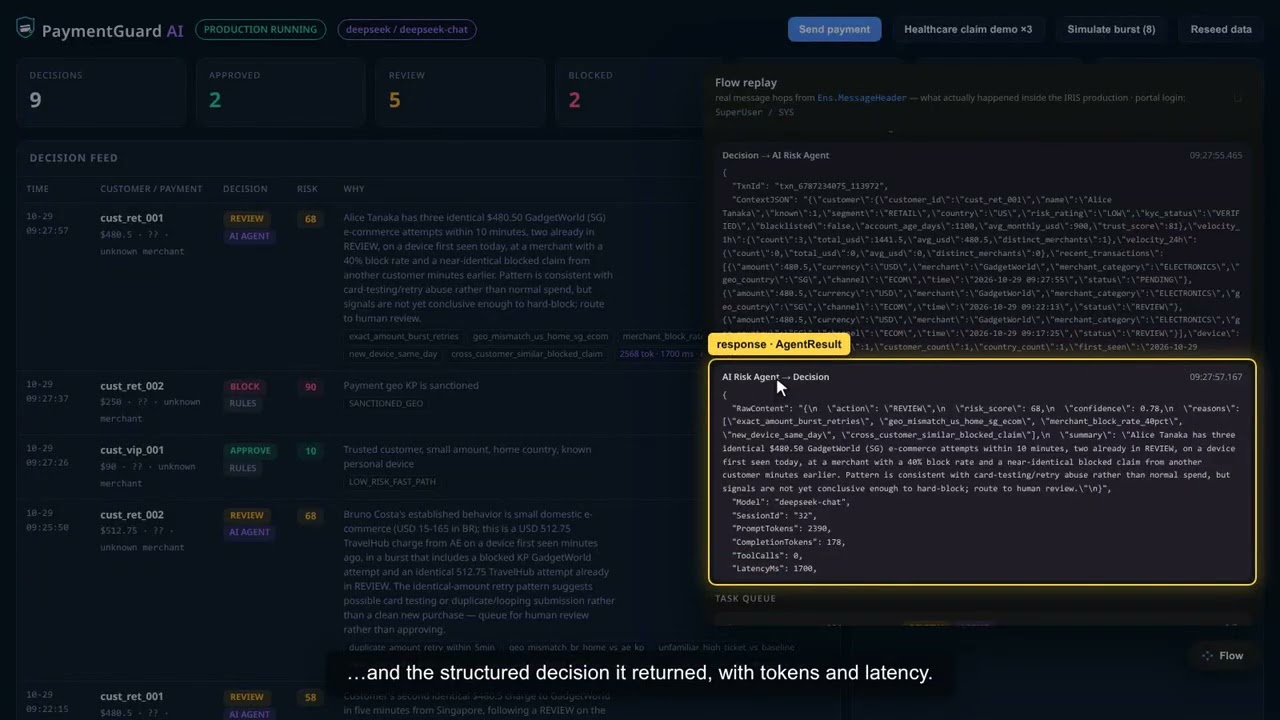
A 4:47 walkthrough: instant rule decisions with zero LLM cost, the gray zone going to the AI Hub agent and its SQL tools, the native Workflow Engine human-review loop, the healthcare claims scenario (cross-city duplicate reimbursement, agent-correlated claims, blacklisted provider), a burst demo where the agent correlates an account-takeover pattern, and the audit trail with tokens, latency and a replayable session id.
Deployment and distribution
-
One command, fully containerized —
docker compose up -d --buildstarts IRIS (AI Hub EAP community image) plus the Web Gateway sidecar (see Quick start). -
Online demo — http://43.139.159.100:8082/paymentguard/: the live dashboard, the REST API at
/paymentguard/apiand the production behind it, deciding in live DeepSeek mode. Management Portal: http://43.139.159.100:8082/csp/sys/UtilHome.csp (SuperUser/SYS). -
IPM package — module
paymentguard. The AI Hub EAP image ships without the IPM client, so install it first in%SYS, then enable the community registry in your application namespace:// %SYS: install the IPM client (same one-liner as iris.script) Set r = ##class(%Net.HttpRequest).%New() Set r.Server = "pm.community.intersystems.com" Set r.SSLConfiguration = "ISC.FeatureTracker.SSL.Config" Do r.Get("/packages/zpm/latest/installer") Do $system.OBJ.LoadStream(r.HttpResponse.Data, "c")// application namespace: enable the community registry and install zpm "enable -community" zpm "install paymentguard"On a stock IRIS instance where IPM is already available, only the last two lines are needed. The package installs the classes, REST web apps and the dashboard into the IRIS CSP directory. The NoPWS AI Hub image still needs the Web Gateway sidecar from this repository for HTTP (
docker compose up -d --buildstarts it); the sidecar also needs the IRIS-side setup from Quick start — theCSPSystemuser,%Service_WebGatewayand the UnknownUser roles — which the Docker path performs automatically. For an IPM-only install the dashboard is athttp://<gateway>/csp/paymentguard/index.html. -
Embedded Python inside — two Python-native components in the decision path: the offline-trained logistic risk prior (
ml_modelin the risk context) and the transaction feature hasher behind vector similarity (see below). Both are[Language = python]methods, pure standard library, no pip packages. -
No API key? Mock mode — the stack runs end-to-end offline: a deterministic engine answers in the same JSON contract, and the whole %UnitTest suite (33 tests) is green without any key.
-
Operations guide — https://github.com/Dylan5237/payment-guard-ai/blob/main/OPERATIONS.md: configuration (including swapping the model at runtime), health checks, failure playbook and security notes for reusing the stack beyond the demo.
-
Sources & media — this repository, the demo video, the Developer Community article and Open Exchange (PaymentGuard-AI).
Architecture

Interactive version with pan/zoom, relationship tracing and per-node source links: https://github.com/Dylan5237/payment-guard-ai/raw/main/docs/architecture.en.html (download and open in a browser).
The production item “PaymentGuard AI Risk Agent” is the contest’s centerpiece: an ordinary Ens.BusinessOperation that hosts the AI Hub agent in-process. A business process talks to the AI exactly like it talks to any other operation — queued, traced in the message viewer, retryable — while the operation internally runs %AI.Agent, persists the session and reports token usage.
Two further items close the loop around the gray zone: “PaymentGuard Human Review” (the native Workflow Engine operation, EnsLib.Workflow.Operation) opens a human task for every REVIEW decision, and “PaymentGuard Review Finalizer” settles or blocks the payment when the analyst answers — see Human review.
The agent
PaymentGuard.Agent.RiskAgent extends %AI.Agent:
| Piece | What it does |
|---|---|
XData INSTRUCTIONS |
Underwriter persona + decision policy + a strict JSON output contract (action, risk_score, confidence, reasons[], summary) |
TOOLSETS |
PaymentGuard.Agent.ToolSet → 6 read-only tools (%AI.Tool methods): customer profile, recent transactions, velocity, device history, merchant profile, semantic similarity search — all live SQL |
| Provider | Environment-driven: AI_PROVIDER (default deepseek), AI_MODEL (default deepseek-chat), <PROVIDER>_API_KEY. Any AI Hub provider works (OpenAI, Anthropic, Gemini, Kimi, GLM/Z.ai, Zhipu, Ollama, …) |
Decision flow detail
- Persist the payment attempt (
PENDING) - Enrich — customer, 1h/24h velocity, last 3 transactions, device reputation, merchant 30-day stats, top-3 vector-similar historical transactions
- Rules — blacklist, failed KYC, sanctioned geo, segment caps, velocity spike →
BLOCK; trusted + small + home + known device →APPROVEfast path. Everything in between is the gray zone - Agent — gray-zone payments are sent (as
PaymentGuard.Request.AgentDecision) to the AI Risk Agent operation; the agent may call its tools, then must answer with JSON; the answer is parsed defensively (Util.JSON.ExtractObject) and validated (Util.Validator.ValidDecision) - Route —
APPROVE→ Settlement,REVIEW→ human review queue (case record) + a native Workflow Engine task for the review role,BLOCK→ fraud alert. When the analyst completes the task, the Review Finalizer process routes the final call (settle or alert), appends theHUMANaudit record and resolves the case - Audit — decision record with reasons, model, session id, tokens, latency; transaction status updated
Quick start
Prerequisites
-
Docker with the IRIS AI Hub EAP community image (contest requirement — note:
the community image, not the plain EAP image; only the community license covers
interoperability). Downloadiris-community-2026.3.0AI.154.0-docker.tar.gz
(amd64) from the Early Access Program portal
(free InterSystems account required), then:docker load -i iris-community-2026.3.0AI.154.0-docker.tar.gz docker images # note the long name of the loaded image docker tag iris-community:2026.3.0AI.154.0 docker pull containers.intersystems.com/intersystems/webgateway:latest-cdThe Dockerfile and
docker-compose.ymluseiris-community:2026.3.0AI.154.0; the
retag step is required because the loaded EAP image comes in with a long internal
name. The EAP image itself is not redistributed with this repository — judges load
it from the portal as above.If you prefer a different local tag, default
ARG IMAGEat the top of the
Dockerfileinstead and keep it consistent withdocker-compose.yml.
Why a Web Gateway sidecar? The 2026.3 AI Hub EAP builds are NoPWS: the
private web server on port 52773 is disabled and there is no Management
Portal listener inside the IRIS container. The stack therefore runs the
standard InterSystems Web Gateway as a second container: it serves the
Management Portal, the REST API and the dashboard over HTTP and talks to
IRIS through the web-gateway protocol on port 1972.
Run
git clone https://github.com/Dylan5237/payment-guard-ai
cd payment-guard-ai
cp .env.example .env         # put your DEEPSEEK_API_KEY in it (or another provider)
docker compose up -d --build # first build: ~2-3 min
Then open:
| What | URL |
|---|---|
| Live dashboard (decision feed, stats, burst simulator) | http://localhost:8082/paymentguard/ |
| Management Portal (production, message viewer) | http://localhost:8082/csp/sys/UtilHome.csp — SuperUser / SYS |
| REST API base | http://localhost:8082/paymentguard/api |
| Production config | Portal → Interoperability → productions → PaymentGuard.Production |
Check that it is working:
curl -s localhost:8082/paymentguard/api/health
# {"app":"paymentguard","production_running":true,"provider":"deepseek","model":"deepseek-chat",
#  "api_key_present":true,"agent_mode":"live"}
production_running must be true; agent_mode reports live with a key and mock
without one.
Without an API key the stack still runs end-to-end in mock mode (/health reports
agent_mode: "mock"): the agent operation answers from a deterministic mock engine, so
you can explore the full flow, dashboard, audit trail and tests with zero external
dependencies. Add a key and recreate the container to go live.
Configuration (.env)
| Variable | Default | Meaning |
|---|---|---|
AI_PROVIDER |
deepseek |
Any %AI.Provider name: openai, anthropic, gemini, kimi, zai, zhipu, xai, openrouter, … |
AI_MODEL |
deepseek-chat |
Model id passed to the provider |
DEEPSEEK_API_KEY |
— | <PROVIDER>_API_KEY for whichever provider you chose (OPENAI_API_KEY, ANTHROPIC_API_KEY, …) |
AI_API_KEY |
— | Generic fallback key |
AI_BASE_URL |
— | Optional custom endpoint for OpenAI-compatible servers |
AGENT_MOCK |
0 |
1 forces the deterministic mock engine even when a key exists |
ADMIN_PASSWORD |
— | Password required by /admin/* endpoints (X-Admin-Password header) |
Every model setting can also be changed at runtime (no restart, takes effect
on the next decision) via PUT /admin/model — see
Operations; the API answers which value is in
effect and where each one comes from (runtime override, env or default).
API
Base: http://localhost:8082/paymentguard/api
The Web Gateway’s Apache module dispatches by file extension, so the stack
internally rewrites extensionless REST URLs to a.csptwin route — both
POST /paymentsandPOST /payments.cspwork from outside.
| Method & path | Description |
|---|---|
GET /health |
Production status, provider/model, live-vs-mock mode |
POST /payments |
Authorize one payment (body below) → full decision incl. tokens & latency |
POST /payments/batch |
{"count": n} (≤25) — generates and decides n mixed-pattern demo payments |
POST /claims |
Submit one health-insurance claim settlement (see below) |
GET /transactions?limit=20 |
Recent payment attempts |
GET /similar?txn_id=…&limit=5 |
Top semantic neighbors of a stored transaction (IRIS Vector Search, cosine similarity) |
GET /trace?limit=300 |
Recent Ens.MessageHeader hops (id, session, source, target, body class, ms timestamps) — powers the Flow replay panel |
GET /messages?session=N |
Every message body of one production session — the object behind each header, serialized to JSON |
GET /reasoning?session=N |
The persisted %AI.Agent.Session message chain (context, tool calls, final answer) |
GET /decisions?limit=20 |
Decision audit trail with reasons, model, tokens, latency, reviewer (for HUMAN rows) |
GET /cases?limit=20 |
Human-review cases and fraud alerts (with resolution + resolver once finalized) |
GET /reviews?limit=20 |
Open human-review tasks from the native Workflow Engine |
POST /reviews/decide |
{"task_id":N,"action":"Approve"|"Reject","reviewer":"RiskAnalyst"} — complete the task; the Review Finalizer settles or blocks the payment |
GET /stats |
Aggregates for the dashboard |
GET /admin/model |
Effective model configuration and where each value comes from |
PUT /admin/model |
Change provider/model/base_url/api_key or flip mock mode at runtime (X-Admin-Password required) |
POST /admin/reseed |
Wipe and reseed demo data (X-Admin-Password required) |
Payment body:
{
  "customer_id": "cust_ret_001",
  "amount": 1850.00,
  "currency": "USD",
  "merchant": "LuxWatch Ltd",
  "merchant_category": "LUXURY",
  "channel": "CARD",
  "geo_country": "NG",
  "device_id": "dev_shared_7"
}
Try a few:
# instant rule-based block (sanctioned geo) curl -s -X POST localhost:8082/paymentguard/api/payments -H "Content-Type: application/json" \ -d '{"customer_id":"cust_ret_001","amount":99,"geo_country":"KP","merchant":"Amazon"}'instant fast-path approve (trusted customer, small, home country, known device)
curl -s -X POST localhost:8082/paymentguard/api/payments -H "Content-Type: application/json"
-d '{"customer_id":"cust_vip_001","amount":90,"geo_country":"US","device_id":"dev_vip_001","merchant":"Amazon"}'gray zone → the AI agent decides (new device, odd geo, elevated amount)
curl -s -X POST localhost:8082/paymentguard/api/payments -H "Content-Type: application/json"
-d '{"customer_id":"cust_ret_003","amount":430,"geo_country":"SG","device_id":"dev_new_9","merchant":"GadgetWorld"}'fraud-flavored burst
curl -s -X POST localhost:8082/paymentguard/api/payments/batch -H "Content-Type: application/json" -d '{"count":8}'
Seeded demo customers: cust_vip_001 (trusted VIP), cust_ret_001..003 (retail, one
KYC-pending), cust_sme_001/002 (business), cust_risk_001 (high-risk), cust_blk_001
(blacklisted) — with ~30 days of history so tools and enrichment return real data.
Human review — native Workflow Engine
Every REVIEW decision — whether the gray-zone agent asked for a human or the
fail-safe fallback kicked in — opens a task in IRIS’s native Workflow Engine
(EnsLib.Workflow):
- The Decision BP sends an
EnsLib.Workflow.TaskRequest(async, no timeout)
to the PaymentGuard Human Review operation; the task lands in the
PaymentGuard Human Reviewrole with the full decision context as its
message payload andApprove,Rejectas its actions. The message trace shows
the session waiting on the human. - An analyst completes the task from the dashboard’s Human review panel or
viaPOST /reviews/decide. The Workflow Engine’s task lifecycle does the
bookkeeping (worklist items, claim/assign, completion). - The Review Finalizer business process then finalizes the payment inside
the production — routes settlement or fraud alert, appends an immutable
HUMANaudit record (with the reviewer’s name), flips the transaction to
SETTLED/BLOCKEDand resolves the review case. Conservative by design:
only an explicit Approve settles; a reject — or anything else — blocks.
# a gray-zone payment lands in review…
curl -s -X POST localhost:8082/paymentguard/api/payments -H "Content-Type: application/json" \
  -d '{"customer_id":"cust_ret_002","amount":600,"geo_country":"SG","device_id":"dev_rev_1","merchant":"GadgetWorld"}'
# …which opens a workflow task
curl -s localhost:8082/paymentguard/api/reviews
# the analyst decides — the finalizer settles or blocks, fully traced
curl -s -X POST localhost:8082/paymentguard/api/reviews/decide -H "Content-Type: application/json" \
  -d '{"task_id":1,"action":"Approve","reviewer":"RiskAnalyst"}'
Healthcare claims scenario
The same production also decides health-insurance claim settlements. A claim
is simply a payment that carries a procedure: the endpoint vocabulary maps onto
insurance vocabulary — member_id (the insured member) becomes the customer,
provider (the hospital/clinic) becomes the merchant, and procedure /
diagnosis / city ride along through the entire pipeline — deterministic
rules, enrichment, agent context and the audit trail — unchanged.
Two deterministic claim rules extend the rule engine:
- Duplicate cross-city claim — the same member settling the same procedure
in another city within 7 days of an already-settled claim → instant
BLOCK(DUPLICATE_CROSS_CITY_CLAIM). - Provider blacklist — providers reuse the merchant blacklist mechanism →
instantBLOCK(BLACKLISTED_MERCHANT).
Everything else flows to the AI agent, whose instructions include the claim
vocabulary and the duplicate-reimbursement pattern, so it correlates a claim
against the member’s settlement history on its own.
Demo: duplicate reimbursement, three shots, three mechanisms
Seed data: member memb_001 (Zhang Wei) settled a full-price cataract surgery
(CNY 12,800) at Shanghai Renji Hospital 3 days ago.
Shot 1 — the same surgery filed in Beijing: the rule engine blocks instantly.
curl -s -X POST localhost:8082/paymentguard/api/claims -H "Content-Type: application/json" \
  -d '{"member_id":"memb_001","provider":"Beijing Union Medical College Hospital","procedure":"CATARACT_SURGERY","diagnosis":"H25.9","amount":12800,"city":"Beijing","currency":"CNY"}'
{"txn_id":"txn_6787132142_141860","action":"BLOCK","source":"RULES","risk_score":90,"confidence":1,
 "reasons":["DUPLICATE_CROSS_CITY_CLAIM"],
 "summary":"Insured member settled procedure CATARACT_SURGERY in Shanghai within the last 7 days (prior claim claimhist_memb_001_CATARACT_SURGERY_3 on 2026-10-25 00:00:00) - duplicate cross-city reimbursement",
 "model":"","session_id":"","prompt_tokens":0,"completion_tokens":0,"latency_ms":0,"decision_id":"7"}
Shot 2 — the same surgery back in Shanghai (same city, so the rule passes):
the gray-zone claim reaches the AI agent, which correlates it with the member’s
history — the Shanghai settlement, the Beijing block — and declines with a
reason a human adjuster can read:
curl -s -X POST localhost:8082/paymentguard/api/claims -H "Content-Type: application/json" \
  -d '{"member_id":"memb_001","provider":"Shanghai Renji Hospital","procedure":"CATARACT_SURGERY","diagnosis":"H25.9","amount":12800,"city":"Shanghai","currency":"CNY"}'
{"txn_id":"txn_6787132181_575310","action":"BLOCK","source":"AGENT","risk_score":92,"confidence":0.9,
 "reasons":["duplicate_reimbursement","same_procedure_multiple_cities","same_procedure_settled_3_days_ago","prior_attempt_blocked_today","amount_matches_duplicate_exactly"],
 "summary":"Member Zhang Wei already has CATARACT_SURGERY (H25.9) settled at Shanghai Renji Hospital on 2026-10-25 for CNY 12,800; a further identical claim was attempted at Beijing Union Medical College Hospital today and blocked, and now the same procedure/amount is presented again in Shanghai. This is a duplicate reimbursement attempt across providers/cities and should be declined and escalated.",
 "model":"deepseek-chat","session_id":"1","prompt_tokens":1985,"completion_tokens":154,"latency_ms":1834,"decision_id":"8"}
Shot 3 — a claim from a blacklisted provider: instant block, no LLM involved.
curl -s -X POST localhost:8082/paymentguard/api/claims -H "Content-Type: application/json" \
  -d '{"member_id":"memb_002","provider":"Sunrise Wellness Center","procedure":"PHYSICAL_EXAM","diagnosis":"Z00.0","amount":980,"city":"Shenzhen"}'
{"txn_id":"txn_6787132196_629126","action":"BLOCK","source":"RULES","risk_score":90,"confidence":1,
 "reasons":["BLACKLISTED_MERCHANT"],
 "summary":"Merchant/provider Sunrise Wellness Center is on the platform blacklist",
 "model":"","session_id":"","prompt_tokens":0,"completion_tokens":0,"latency_ms":0,"decision_id":"9"}
POST /api/claims body: member_id and amount are required; provider,
procedure, diagnosis, city, currency (defaults to CNY), claim_time and
geo_country (defaults to CN) are optional.
Seeded demo members: memb_001 (premium plan, the demo trigger above),
memb_002 (premium), memb_003 (retail, dialysis patient with a 3-week
hemodialysis history in Guangzhou), memb_004 (business plan) — plus settled
claim history at Shanghai Renji Hospital, Beijing Union Medical College
Hospital, Guangzhou First People’s Hospital and the blacklisted Sunrise
Wellness Center.
Semantic similarity — IRIS Vector Search + Embedded Python
Fraud evidence often looks like “this resembles something we have seen
before”. PaymentGuard encodes that instinct with IRIS Vector Search:
- Embedding —
PaymentGuard.Vector.Embedderis an Embedded Python
method that hashes the structured transaction features (procedure,
diagnosis, provider, city, channel, amount band, currency, …) into a
256-dimension L2-normalized vector. Pure standard library: deterministic,
offline, no external embedding API — identical inputs always produce the
identical vector. - Storage — every transaction persisted by the production gets its
Embedding(VECTOR(double, 256)column) written after the row is
final; seeded history is backfilled the same way. - Retrieval —
VECTOR_COSINEtop-K queries power two paths:- a
similar_transactionssection in every gray-zone risk context
(pre-computed evidence, always in the prompt), and - a
SearchSimilarTransactionsagent tool, so the underwriter agent can
pull semantic neighbors on demand mid-reasoning.
- a
- Inspection —
GET /similar?txn_id=…returns the neighbors with
similarity scores.
Example: querying the seeded Shanghai cataract settlement finds the same
member’s Beijing attempt at 0.82 and unrelated MRI claims at 0.31 — the
duplicate-reimbursement pattern surfaces as a similarity ranking, and the
agent cites it (same_procedure_attempted_in_second_city_same_hour):
curl -s "localhost:8082/paymentguard/api/similar?txn_id=claimhist_memb_001_CATARACT_SURGERY_3&limit=3"
Observability
- Message viewer: every hop — REST entry, decision process, agent operation call,
settlement/review/alert routing — is a traced interoperability message. - Decision audit table (
PaymentGuard.Data.Decision): source, action, risk score,
reason codes, human-readable summary, model, AI Hub session id, prompt/completion
tokens, tool calls, latency. - Sessions: each agent decision’s conversation is
%Save()d; replay any decision with
##class(%AI.Agent.Session).%OpenId(<id>). - Dashboard shows live token spend and average agent latency next to approval metrics.
- Flow replay — the dashboard’s Flow panel replays any decision hop by hop over the
production topology with the realEns.MessageHeadertimings (GET /trace), unfolds the
agent’s reasoning chain (GET /reasoning), and lets you click a topology node to read the
actual message bodies that passed through it (GET /messages). - Portal deep link — the same session opens in the Management Portal Message Viewer
(EnsPortal.MessageViewer.zen?SESSIONID=…, loginSuperUser/SYS), so the replay is
a convenience layer over the tooling IRIS already ships. - Typical latency — rules decide in single-digit milliseconds at zero tokens; gray-zone
agent decisions land in ~1.4–1.9 s end to end with ~2.5k prompt tokens. A slow or hung LLM
is capped at 20 s and degrades to a human-review item, never wedging the pipeline.
Testing
In the container:
docker compose exec iris iris session iris -U IRISAPP
IRISAPP>do ##class(PaymentGuard.Tests.Suite).RunAll()
The suite covers the rule engine branches, defensive JSON parsing/validation, an
end-to-end production run in mock mode (blocked, fast-approved, gray-zone, fraud-pattern
and audit-trail cases), the healthcare claims scenario (endpoint mapping, the
duplicate cross-city rule, the provider blacklist and the agent-correlated claim
flow), the vector search layer (embedding determinism, seeded-claim retrieval,
context injection, self-exclusion, end-to-end embedding), and the human-review
workflow (task creation for REVIEW decisions, claim + complete, approve→settlement
and reject→block finalization with audit and case resolution) — it runs offline,
no API key needed.
Project structure
├── Dockerfile / docker-compose.yml / merge.cpf / iris.script   # container build on the EAP image
├── webgateway/                    # Web Gateway sidecar config (CSP.ini + Apache conf)
├── module.xml                     # IPM package: classes, web apps, dashboard files, install hook
├── src/PaymentGuard/
│   ├── Agent/       RiskAgent (%AI.Agent), Tools (%AI.Tool), ToolSet (%AI.ToolSet)
│   ├── Interop/     Production, DecisionBP, AgentOperation, Settle/Review/Alert BOs
│   ├── REST/        Dispatch (%CSP.REST), BS (EnsLib.REST.Service)
│   ├── Rules/       RuleEngine, Mocker (deterministic offline engine)
│   ├── Vector/      Embedder — Embedded Python feature hasher + cosine search
│   ├── Data/        Customer, Transaction, Decision, CaseRecord, Enricher, Populate
│   ├── Request/ Response/ Msg/    interoperability messages
│   ├── Util/        Config, JSON, Validator, Setup
│   └── Tests/       %UnitTest suite
└── web/index.html   live dashboard (served from /csp/paymentguard)
Notes & limitations
- Demo web apps are unauthenticated for convenience — protect them before any real use.
- The mock engine is a deterministic stand-in, not a model: it exists so the flow, tests
and dashboard work without an API key. - EAP software: APIs may change before GA.
License
MIT
Last checked by moderator
30 Oct, 2026, Works
Checked on IRIS for UNIX (Ubuntu Server LTS for x86-64 Containers) 2026.3.0AI (Build 154U) Thu Sep 24 2026 10:04:49 EDT
Made with
Install
 zpm install paymentguard
 download archive
Version
1.0.206 Nov, 2026
Categories
 AI AgentsSolutions
Works with
InterSystems IRISFirst published
27 Oct, 2026Last edited
06 Nov, 2026