
© 2026 InterSystems Corporation. All rights reserved.Privacy & TermsGuaranteeSection 508Contest Terms


iris-fhir-portal

Community Project
This project is maintained by its author and is not officially supported by InterSystems. For technical support, please contact the project developer.
This project is maintained by its author and is not officially supported by InterSystems. For technical support, please contact the project developer.
5
1 reviews
2
Awards
1.5k
Views
1.2k
IPM installs
 1
 Add to bundle

Details
Releases (10)
Reviews (1)
Awards (2)
Issues
Articles (6)
Patient Chart using FHIR Resources
What's new in this version
Automatic version update
IRIS FHIR Portal

A patient chart built on the FHIR server of InterSystems IRIS for Health. It shows how far you can get with FHIR REST, the SQL view of the FHIR resources and Patient/$everything, and it is the companion of four articles on the InterSystems Developer Community (see Articles).

Prerequisites
Make sure you have git and Docker desktop installed.
Installation
Clone/git pull the repo into any local directory
$ git clone https://github.com/diashenrique/iris-fhir-portal.git
Open the terminal in this directory and run:
$ docker compose up -d
The image is built on intersystems/irishealth-community:latest-cd (InterSystems IRIS for Health 2026.2), the same release channel used by sentai-task. The FHIR R4 server uses the JsonAdvSQL storage strategy, so its SQL schemas are HSFHIR_X0001_R and HSFHIR_X0001_S.
The portal requires a login. Open http://localhost:32783/fhir/portal/diashenrique.fhir.portal.Home.cls and sign in as the demo user fhirportal / fhirportal (no roles), created during the build. One IRIS session then covers the pages, the FHIR endpoint /fhir/r4 and the REST API /fhir/api; the Logout link at the top ends it. Do not expose this container outside your machine.
Checking your Docker installation
CI runs these checks on every pull request and push to master. To run them against your local container (Docker Compose setup only; set BASE_URL for both if you changed the port, default http://localhost:32783):
$ bash scripts/smoke.sh
signs in and checks the FHIR server, the /fhir/api REST routes, both pages, and that nothing answers without a login or after logout. bash scripts/check-readonly.sh checks that the roles of /fhir/api can read the FHIR tables and cannot write to them, and bash scripts/check-readme-sql.sh runs the SQL examples of the documentation. The browser tests need Node.js 22 or later. They sign in and go through the list, the chart, Edit, the lab chart, the Timeline, the languages and logout; the data they create or change is removed or restored at the end:
$ cd e2e
$ npm ci
$ npx playwright install chromium
$ npx playwright test
On a fresh Linux machine, use npx playwright install --with-deps chromium to also get the browser’s system libraries.
The frontend libraries come from npm through vendor/ (see https://github.com/diashenrique/iris-fhir-portal/blob/master/vendor/README.md and https://github.com/diashenrique/iris-fhir-portal/blob/master/vendor/INVENTORY.md). CI checks that the files in fhirUI/assets/vendor match the lockfile and runs npm audit on them. To run the same check locally: cd vendor && npm ci --ignore-scripts && node sync.mjs --check.
Installation via IPM
The portal needs IRIS for Health with a FHIR R4 server at /fhir/r4 that uses the JsonAdvSQL storage strategy, for example the fhir-server package of iris-fhir-template. Install the portal in the namespace of that server, after it:
zn "FHIRSERVER"
zpm "install fhir-portal"
The module (version 1.1.0 or later) creates everything the Docker setup has, through diashenrique.fhir.portal.Installer:
- the web apps
/fhir/portaland/fhir/api, both with password login; - one session shared with
/fhir/r4; - the roles
FHIRPortalRead(read-only FHIR databases) andFHIRPortalAPI(SELECT on the endpoint’s SQL schemas and EXECUTE on the JSON SQL functions).
The Docker image installs the portal through the same module.
Open http://your-server:port/fhir/portal/diashenrique.fhir.portal.Home.cls and sign in with an IRIS user. To also create the demo login fhirportal / fhirportal, pass the module parameter. With IPM 0.10, the -Dzpm. form does not reach the module:
zpm "install fhir-portal -DDemoUser=1"
Installed in a namespace without /fhir/r4 (for example USER, before the FHIR server exists), the module only prints a warning and configures nothing. zpm "uninstall fhir-portal" removes the two web apps, the roles and the demo user. The session settings stay on /fhir/r4.
On IRIS for Health 2026.2, fhir-server 1.3.7 fails when it creates the FHIRSERVER namespace itself. scripts/ipm-install.sh shows the workaround CI uses: create the namespace first and map IPM into it. To check the whole IPM path in a clean container on port 42783:
$ bash scripts/ipm-install.sh
$ BASE_URL=http://localhost:42783 bash scripts/smoke.sh
How the portal reads FHIR data
The portal reads the same FHIR data three ways, and every card says which one it uses:
- FHIR REST with fhir.js (badge FHIR · fhir.js): the patient list, the summary and the clinical cards search
/fhir/r4, and Edit saves the patient with a FHIRupdate. These are articles 1 to 3. - SQL through
/fhir/api(badge SQL · /fhir/api): the lab chart. The REST classdiashenrique.fhir.portal.Dispatchruns SQL on the tables of the FHIR server, with the JSON functionsGetJSON,GetPropandGetAtJSONof article 4 (src/User/SQLvar.cls). It asks the storage strategy of/fhir/r4for the table names, and the role of/fhir/apican only read them. Patient/$everything(badge FHIR · $everything): the Timeline, from one call.
The FHIR server uses the JsonAdvSQL storage strategy: HSFHIR_X0001_R.Rsrc holds every resource as JSON, and HSFHIR_X0001_S.<Resource> holds its search parameters. These are the queries of /fhir/api, with a sample patient in place of the ? parameter.
The lab tests of a patient, for the chart picker (GET /fhir/api/laboptions/:id):
SELECT DISTINCT
  GetProp(GetJSON(GetAtJSON(GetJSON(GetJSON(r.ResourceString,'code'),'coding'),0),'code'),'code') AS testCode,
  GetProp(GetJSON(GetAtJSON(GetJSON(GetJSON(r.ResourceString,'code'),'coding'),0),'display'),'display') AS testName
FROM HSFHIR_X0001_S.Observation s
JOIN HSFHIR_X0001_R.Rsrc r ON r.Key = s.Key
WHERE s.patient_Reference = (SELECT TOP 1 patient_Reference FROM HSFHIR_X0001_S.Observation)
  AND r.ResourceType = 'Observation' AND r.Deleted = 0
  AND GetProp(GetJSON(GetAtJSON(GetJSON(GetJSON(r.ResourceString,'category'),'code'),0),'code'),'code') = 'laboratory'
ORDER BY testName
The results of one test, for the chart (GET /fhir/api/patient/:id/lab/:code, here LOINC 718-7, hemoglobin):
SELECT
  GetProp(GetJSON(GetAtJSON(GetJSON(GetJSON(r.ResourceString,'code'),'coding'),0),'display'),'display') AS testName,
  GetProp(GetJSON(r.ResourceString,'effectiveDateTime'),'effectiveDateTime') AS effectiveDateTimeValue,
  GetProp(GetJSON(r.ResourceString,'valueQuantity'),'value') AS valueQuant
FROM HSFHIR_X0001_S.Observation s
JOIN HSFHIR_X0001_R.Rsrc r ON r.Key = s.Key
WHERE s.patient_Reference = (SELECT TOP 1 patient_Reference FROM HSFHIR_X0001_S.Observation)
  AND r.ResourceType = 'Observation' AND r.Deleted = 0
  AND GetProp(GetJSON(GetAtJSON(GetJSON(GetJSON(r.ResourceString,'category'),'code'),0),'code'),'code') = 'laboratory'
  AND GetProp(GetJSON(GetAtJSON(GetJSON(GetJSON(r.ResourceString,'code'),'coding'),0),'code'),'code') = '718-7'
ORDER BY effectiveDateTimeValue
https://github.com/diashenrique/iris-fhir-portal/blob/master/misc/sql/example.sql has the step-by-step examples of article 4. CI runs every SQL example of this README, of README-JP and of that file against the FHIR server (bash scripts/check-readme-sql.sh), so they keep working.
Using the portal
Open http://localhost:32783/fhir/portal/diashenrique.fhir.portal.Home.cls and sign in as fhirportal / fhirportal.
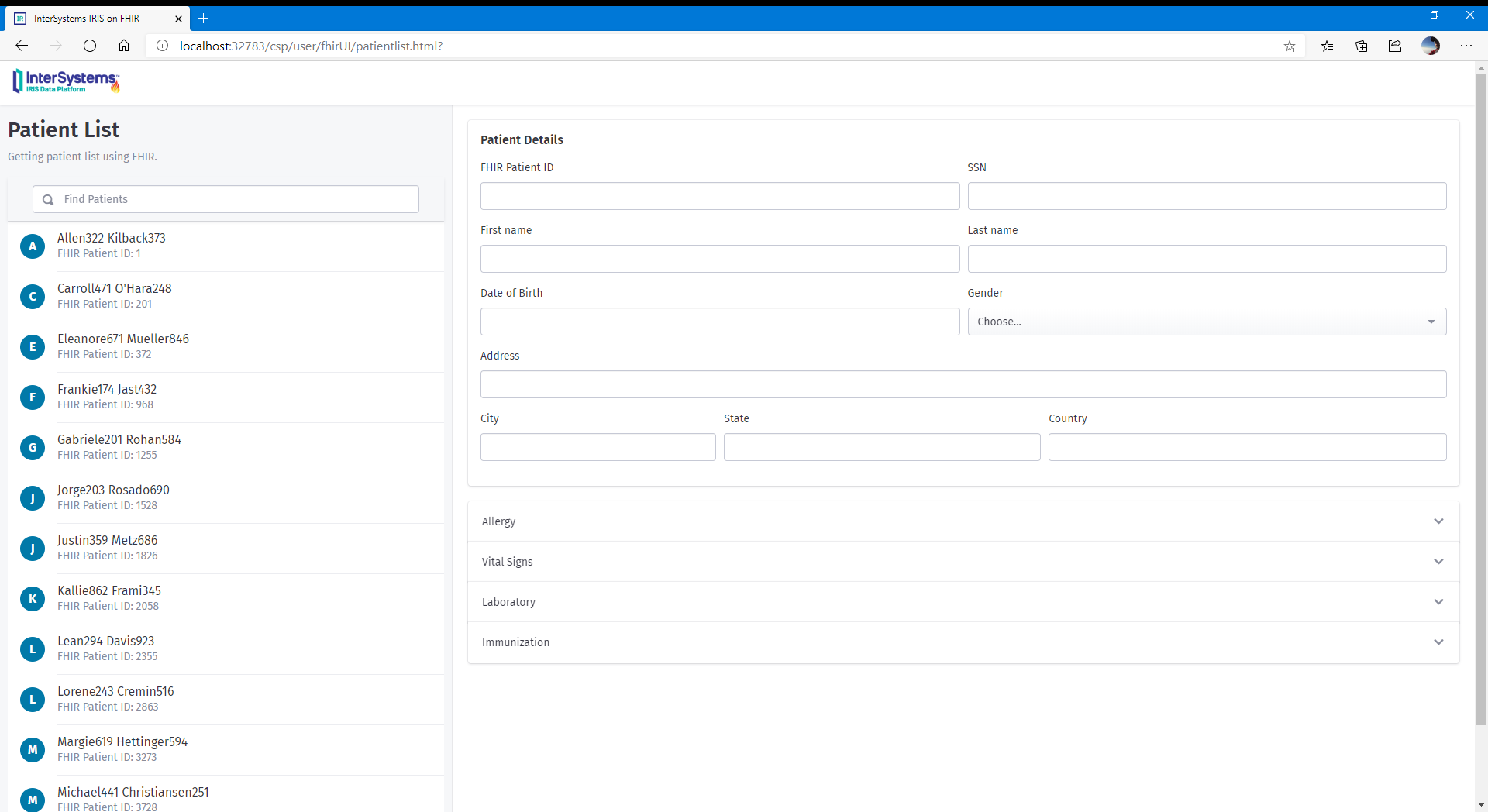
- Patient list: on the left, with age, sex and FHIR id. Type to search by name or id, or press
/to get there; the arrow keys move through the list. - Summary: choosing a patient shows who they are at the top, with the allergy alert and the count of active conditions. Edit opens the demographics in a modal and saves them with a FHIR
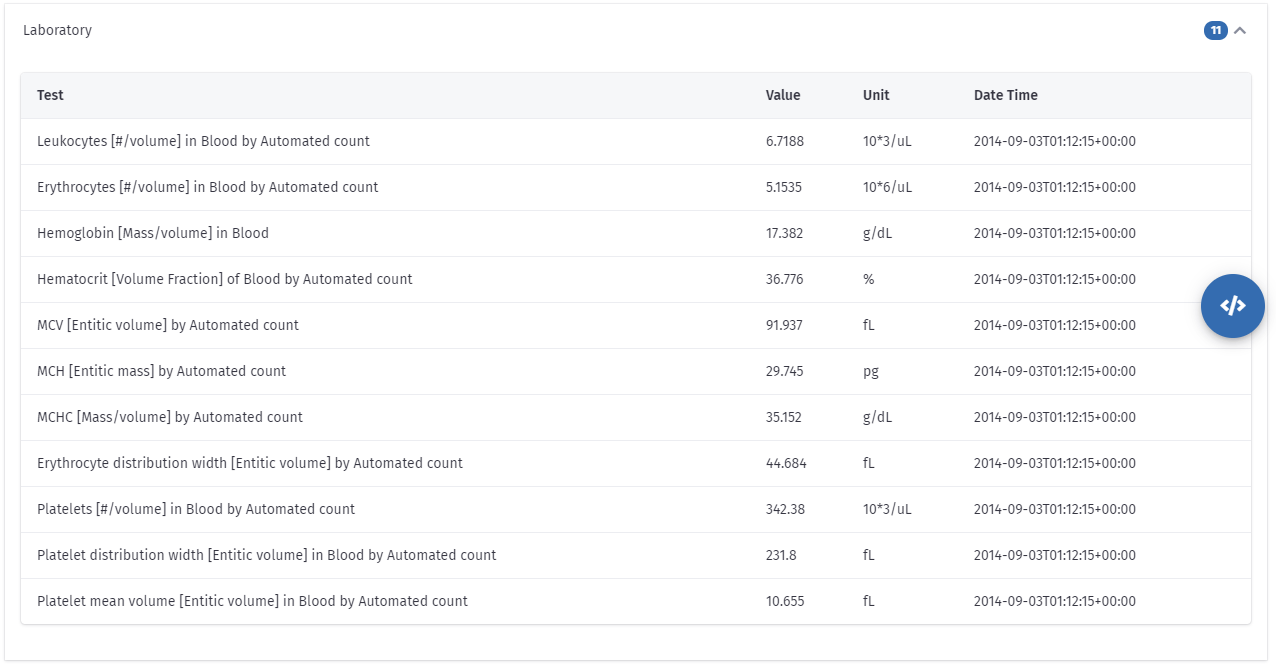
update(article 3). FHIR JSON shows the raw Patient resource; the SSN stays masked until you choose Reveal. - Clinical cards: always open, each with its count, the source of its data and its own loading, empty and error states. They are Allergies, Conditions, Medications, Vital signs (the latest value of each measure), Laboratory (grouped by day, with reference ranges and High or Low values flagged), Immunizations, Encounters and Care plans.
Lab chart: choose a test in the Laboratory card and its chart draws right there, with the unit and the reference range. The values come from SQL through /fhir/api (article 4).

Timeline: the Timeline tab lists every dated event of the patient (encounters, conditions, procedures, immunizations, prescriptions and reports) by year, from one call to Patient/$everything. Filter it by type.

Edit:

On a phone: the list and the chart take turns, and nothing scrolls sideways.

Português: the language picker in the header switches the interface to Brazilian Portuguese, dates and numbers included. Clinical data stays as the FHIR server sends it.

The screenshots come from cd e2e && node screenshots.js, with the container running.
Articles
The portal was written for the 2020 FHIR contest and explained in four articles on the InterSystems Developer Community:
- My experience working with FHIR
- Overview of iris-fhir-portal
- Updating Patient resource using fhir.js
- Getting FHIR information using SQL
They describe the portal of 2020. iris-fhir-portal, six years later tells what changed since then, with errata for each of the four articles.
In short, since then it moved to IRIS for Health 2026.2 and the JsonAdvSQL schemas (HSFHIR_X0001_*), gained a login, a read-only /fhir/api, an IPM module and the layout above. How the portal reads FHIR data has the current SQL.
Last checked by moderator
25 Aug, 2026,
Made with
Install
 zpm install fhir-portal
 download archive
Version
1.0.325 Mar, 2024
ObjectScript quality test
 PassedView report
Category
Technology ExampleWorks with
InterSystems IRIS for HealthFirst published
18 Aug, 2020Last edited
25 Mar, 2024